
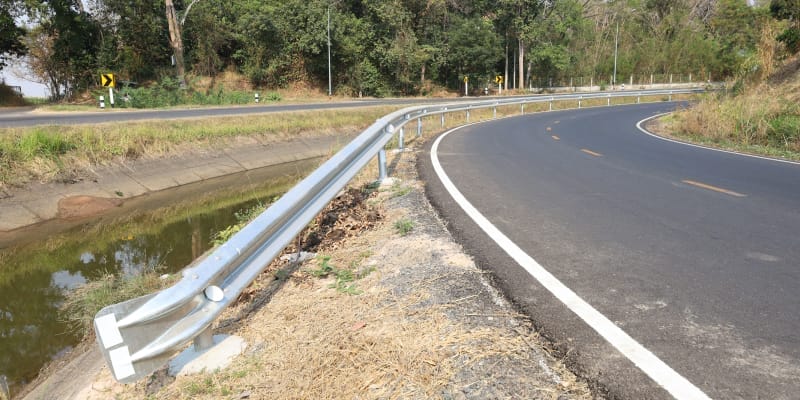
Crash barriers are essential safety structures designed to:
- Reduce accidents.
- Protect lives.
- Ensure both road safety and worksite protection.
That said, choosing the right road crash barrier is more than a simple logistical task — it is a critical safety decision that demands careful attention because an incorrect choice can lead to:
- Safety risks
- Compliance challenges
- Costly project delays
Therefore, a systematic evaluation of site conditions, together with guidance from manufacturers — such as W Beam crash barrier manufacturers — is essential to select a barrier that meets safety and regulatory standards.
This guide provides a step-by-step framework to navigate essential considerations and make informed, confident decisions when choosing a road crash barrier.
Key Factors to Consider When Choosing a Road Crash Barrier
Understanding how to choose the right road crash barrier requires careful consideration of site conditions, barrier types, compliance requirements, and durability factors.
Let’s take a closer look at these factors — one at a time.
Initiate Your Selection With a Thorough Site Assessment
The selection process begins with a comprehensive site assessment. If the barrier does not match your specific site requirements, it will not perform effectively, regardless of its inherent strength.
- Begin by analysing your location: is it a highway, a bridge, a sharp curve, or a construction worksite?
- Next, evaluate traffic conditions by considering both the prevailing speed limits and the mix of vehicle types using the road. For instance, higher speeds and heavier vehicles necessitate a barrier with greater impact resistance.
- Equally important, identify physical site hazards — such as loose ground, sharp curves, and tight spaces.
- Finally, assess the space available behind the barrier line, as it determines the maximum acceptable deflection. For example, on a dual carriageway, a barrier with high deflection could intrude into the opposing lane — creating a severe hazard.
This thorough site assessment defines the key performance criteria — impact resistance and deflection limits — and forms the essential first step in establishing a robust foundation for your project's safety.
Understand the Main Categories of Road Crash Barriers
Road crash barriers serve different purposes depending on site conditions and safety requirements. They are generally divided into three main categories:
- Rigid Barriers (Made of Concrete): Designed to redirect an errant vehicle with minimal deflection. This characteristic makes them a suitable choice for high-speed zones or confined spaces — such as on bridges and along highway medians — where almost no movement is acceptable.
- Semi-Rigid Barriers (Like W-Beam Guardrails): Engineered to provide a different barrier response. These systems absorb a portion of the impact energy by flexing in a controlled manner, which helps to reduce the collision's severity and prevent a vehicle from crossing into a hazardous area.
- Flexible Barriers (With High-Tension Cable Barriers): Designed to absorb significant energy, these barriers undergo substantial deflection upon impact. Therefore, a large, clear deflection zone behind the installation is essential for them to function safely and effectively.
Beyond the main barrier sections, a complete safety system also incorporates ancillary components — such as crash cushions and end terminals.
- Crash cushions are installed in front of fixed hazards — like bridge piers — to safely absorb head-on impacts.
- End terminals are designed to safely terminate a barrier run — preventing the exposed end from becoming a severe hazard.
Ultimately, these features define the function and performance of each barrier type.
Also Read :Exploring W Beam Fence Uses in Road Safety
Verify Compliance With Critical Safety Regulations and Standards
Securing compliance with safety standards is a non-negotiable step — it is your fundamental guarantee that a barrier will perform as intended when it is needed most.
The key benchmarks for this, which are critical for establishing performance, include:
- IRC standards (Indian Roads Congress specifications for road safety barriers)
- IS codes (Bureau of Indian Standards for manufacturing and testing)
You must also verify compliance with local regulatory requirements and applicable standards, as specific projects may have unique mandates.
- Failing to comply with these local rules risks project suspension and fines, which can derail your timeline and budget.
The National Highways Authority of India (NHAI) has issued strict guidelines for Metal Beam Crash Barriers (MBCBs), ensuring compliance with technical specifications, material quality, post spacing, and installation methods, aligned with IRC:119-2015 and MoRTH circulars. Proper selection involves considering traffic volume, vehicle types, and road speed, while installation must follow manufacturer instructions without welding to maintain structural integrity. Mandatory embossing, QR codes, and certification of materials enhance traceability and accountability. Regular ground compaction checks, quality audits by NHAI field officers, and safety evaluations by road safety auditors further ensure barriers perform effectively. These measures collectively strengthen protection for road users and play a critical role in reducing highway accidents nationwide.
Evaluate the Durability and Lifecycle Factors of the Barrier
The crucial step for your project’s budget and long-term safety is to weigh the total lifecycle cost, which includes the initial installation costs alongside ongoing maintenance costs and overall durability.
For example:
- Concrete barriers involve high upfront installation costs, but they are a low-maintenance option that lasts for decades.
- Cable barriers offer affordability but may require more frequent maintenance — such as tension adjustments.
The durability of a barrier is heavily influenced by the environmental and weather conditions of its installation site.
For instance:
- In coastal areas, salt exposure accelerates corrosion and rusting, which compromises the barrier’s structural integrity.
In these harsh environments, using corrosion-resistant materials — like galvanised steel — is essential to ensure long-term performance.
Ultimately, balancing cost with long-term durability is the key to getting the best value and ensuring sustained safety.
Ensuring Maximum Site Safety With the Right Barrier
Choosing the right road crash barrier requires careful consideration of its:
- Impact resistance
- Type
- Cost
- Compliance with safety standards
This investment directly protects lives — ensuring the road safety of the workers, crew, and pedestrians at the site.
Unsure which barrier offers the best suitability for your complex project? It is wise to get expert advice. At MKK Metal Sections Pvt. Ltd. — a leading steel product manufacturer and supplier in Chennai — we:
- Assess your site.
- Recommend the optimal barrier type.
- Deliver fully compliant solutions.
Request a consultation with us today — ensure maximum safety and protection for your project!